Native Potato Starch - Food Ingredient and Bulk Supply

Food-Grade Native Potato Starch for Food Manufacturing

If your formulation needs heat-activated thickening, binding, gel structure, water retention or texture control, Native Potato Starch is a practical starting point. We support food manufacturers, importers and distributors with bulk supply, sample evaluation, technical documents and application-focused specification discussion.

This page is written for buyers searching for native potato starch, food grade potato starch, potato starch manufacturer, bulk potato starch supplier, potato starch for sauces, potato starch for noodles, potato starch for meat products and potato starch for fabricated chips. Instead of treating starch as a generic white powder, we explain how gelatinization, viscosity, shear, acid, heat and storage conditions affect your finished product.

Native and unmodifiedFood-grade potato starchHeat-activated gelatinizationThickening and binding25 kg export packagingTDS and COA support
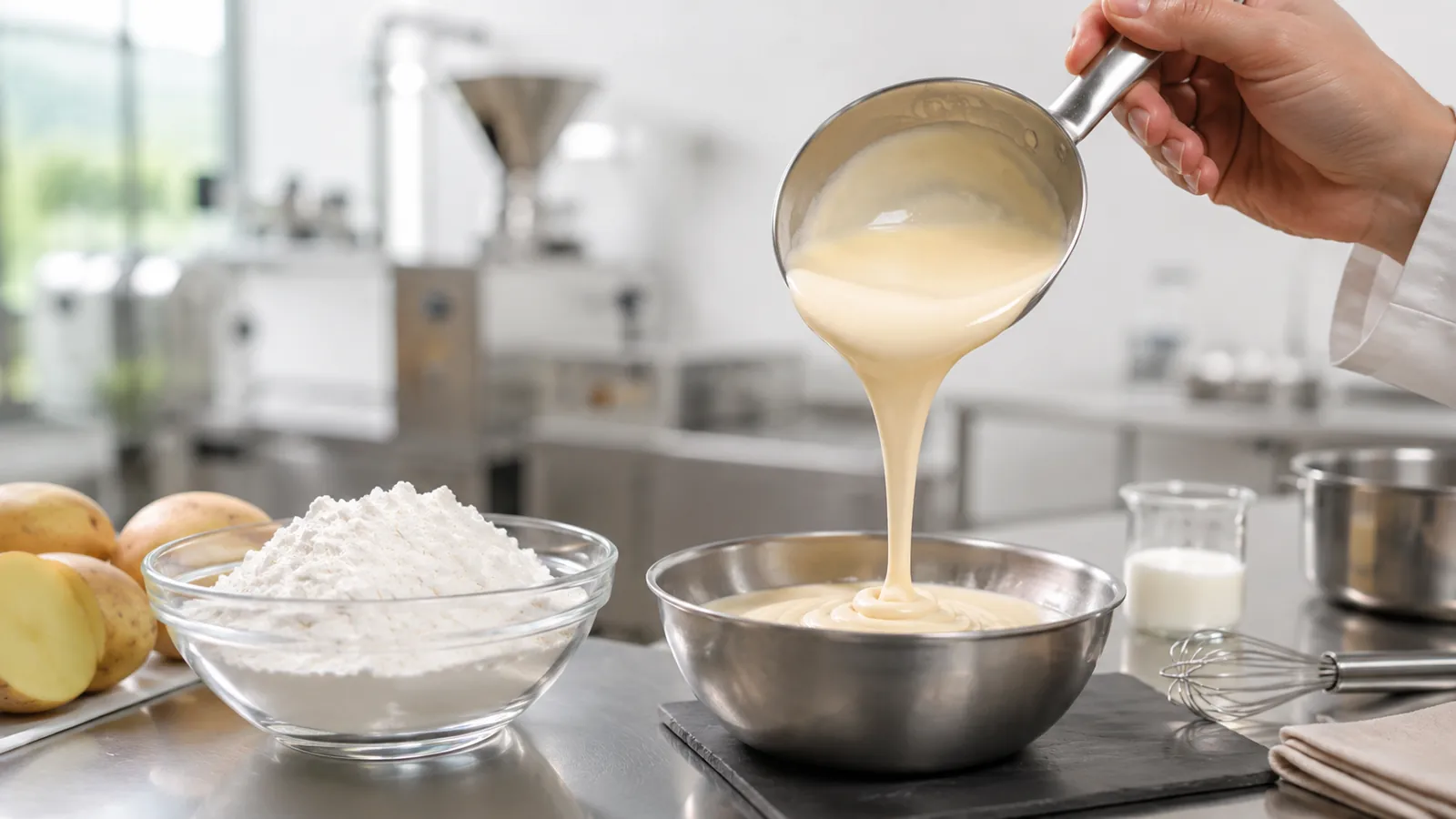
Native potato starch white powder - food-grade bulk supply from Junsheng

Start with your process

Choose Native Potato Starch by the job it must perform

The same starch can behave very differently in a sauce kettle, noodle line, meat system or fabricated-chip dough. Start with the finished food and process stress, then compare viscosity, gel structure, water retention, texture and stability under your real conditions.

01

Soups, Sauces and Gravies

For a heated sauce that needs viscosity, body, gloss or cling, Native Potato Starch is a strong screening route. Share pH, salt, sugar, solids, fat, protein, heating profile and shear so the trial reflects the real formulation rather than a simple starch-water test.

See sauce application guidance →
02

Noodles, Meat and Binding Systems

For noodles, meat products, coatings and prepared foods, buyers often evaluate potato starch for binding, water retention, bite, yield and texture. The useful test includes cooking loss, purge, sliceability and storage texture, not laboratory viscosity alone.

Discuss your formulation →
03

Fabricated Potato Chips and Potato Foods

In fabricated chips, Native Potato Starch may be used with Potato Flakes or Potato Granules to adjust dough structure, binding and crispness. The starch does not replace dehydrated potato solids; each ingredient has a different function in the recipe.

Explore fabricated chip applications →

What is Native Potato Starch?

A physically separated potato starch that develops functionality through heat

Native Potato Starch is obtained from potatoes without chemical modification. In a typical food process it must be dispersed and heated through gelatinization before the starch granules swell and viscosity develops. Temperature, mixing, solids concentration and holding time therefore matter as much as the product name.

For buyers, the word native describes modification status; it does not guarantee that every supplier or batch behaves identically. Raw material, particle profile, moisture, starch damage, analytical method and processing conditions can change viscosity development, paste texture and water-binding performance. A useful supplier comparison combines the current TDS with a controlled side-by-side application trial.

Native Potato Starch should also be separated clearly from Potato Flakes and Potato Granules. Flakes and granules are dehydrated potato solids that contribute potato material, flavor and their own hydration behavior; native starch is primarily a functional starch. If you need potato solids and potato character, review Potato Flakes or Potato Granules. If you need heat-activated thickening or binding, native starch may be the more relevant route.

Buyer specification reference

Confirm the commercial grade and test method before supplier approval

A serious Native Potato Starch quotation should identify the exact commercial grade, test methods and acceptance limits rather than rely on a generic product name. These are the points procurement and QA should place on the TDS review and signed specification.

Product identityNative potato starchConfirm that the grade is native and unmodified and that the ingredient statement matches your target market.
AppearanceFine white powderReview color, odor, foreign matter and any customer-specific visual acceptance criteria.
Particle profileConfirm current sieve specificationParticle size can influence dispersion, dusting and handling. Compare suppliers using the same method.
MoistureConfirm current TDS limitMoisture affects dry-solids basis, storage and commercial consistency. Compare on the same analytical basis.
Viscosity and paste behaviorMethod-specificDo not compare viscosity values unless concentration, instrument, heating curve and reporting unit are the same.
Gelatinization and heatingHeat requiredValidate under your actual heating, shear and holding conditions rather than relying on one laboratory curve.
Packaging25 kg export bag referenceConfirm bag structure, palletization, loading, labeling and private-label requirements before the order.

Website information is for screening, not final contractual acceptance. Commercial supply should be based on the current grade-specific TDS, agreed analytical methods, signed specification and batch COA. If your process needs cold-water thickening, strong acid or shear tolerance, retort stability or repeated freeze-thaw performance, compare Pregelatinized Potato Flour or Modified Potato Starch instead of forcing Native Potato Starch into the wrong application.

Critical technical factors

Six factors that determine whether Native Potato Starch works in your process

The best food grade potato starch is not simply the product with the highest laboratory viscosity. What matters is how the starch disperses, gelatinizes, builds viscosity, binds water and maintains the desired texture under your formula and process. A technical specification can include particle or mesh size, moisture content, bulk density, color, flavor or odor, microbiological limits, shelf life, storage conditions, food safety, traceability, viscosity, gelatinization temperature, gel strength, water-binding capacity, amylopectin or amylose information where relevant, paste clarity, whiteness and pH. Halal and FSSC 22000 evidence should be reviewed against the current scope; if Kosher evidence is required, request it specifically instead of inferring certification. Terms such as pure starch, thickener, binder and texturizer still need to be tied to a defined food application and measurable specification.

01

Gelatinization and Heating Profile

Native Potato Starch normally needs controlled heating to develop viscosity. Heating rate, peak temperature, residence time and solids concentration affect swelling and paste development. A good laboratory sample still needs verification in your kettle, cooker, extruder or continuous line.

02

Viscosity Development

Viscosity is useful only when the method is defined. Concentration, pH, salt, sugar, fat, protein, shear and instrument all change the result. Use the same method for supplier comparison, then confirm the body, cling and flow of the finished food.

03

Water Binding and Yield

In meat systems, fillings, prepared foods and selected doughs, potato starch can support water retention and yield. The commercial question is whether the finished product retains moisture during cooking, cooling, freezing, reheating and storage.

04

Gel and Texture Structure

After gelatinization, Native Potato Starch can contribute body, gel structure, bite and cohesiveness. A sauce may need smooth flow, a noodle may need bite, and a meat product may need binding without a pasty mouthfeel. Evaluate the final texture rather than one isolated starch number.

05

Shear, Acid and Heat Exposure

Native starch has natural process limits. High shear, low pH, long hot holding or severe thermal treatment can reduce viscosity or destabilize texture. If your process is demanding, Modified Potato Starch may be the technically correct route.

06

Cooling, Storage and Freeze-Thaw

Texture can continue changing as the starch paste cools and ages. Refrigerated or frozen foods should be evaluated after the real storage cycle. If syneresis or freeze-thaw stability is critical, include an appropriate modified grade in the same comparison.

High-intent application - soups, sauces and gravies

Native Potato Starch for sauces: validate viscosity in the complete formulation

For buyers searching for potato starch for sauces, soups, gravies or fillings, the central question is how viscosity develops under the real formulation. A laboratory value without pH, salt, sugar, fat, heating and shear context is not enough to approve a bulk supplier.

Build the trial around your real process: preblend or direct addition, starting temperature, heating curve, agitation, cook time and hot holding. Record flow, cling, gloss, mouthfeel and viscosity at the temperature where the product is actually filled, served or consumed.

If the process is cold-mix or needs immediate viscosity before heating, standard Native Potato Starch is usually not the right route. Pregelatinized Potato Flour can be a better starting point for rapid hydration, while Modified Potato Starch should be compared when acid, shear, retort, refrigeration or freeze-thaw stability is the main issue.

  • Formula solids and water level
  • pH and acid source
  • Salt and sugar concentration
  • Fat and protein system
  • Addition sequence and dispersion
  • Heating curve and cook time
  • Mixing and shear intensity
  • Hot-hold duration
  • Final flow, cling and mouthfeel
  • Cooling and storage stability
Discuss Potato Starch for Your Sauce
Potato starch thickened sauce showing a clear, glossy gel texture

More Native Potato Starch applications

Match starch function to the finished-food problem

Native Potato Starch is used across many heated food systems, but the reason for using it changes by application. These routes help procurement and R&D teams define the performance target before requesting a grade or sample. Food applications include thickening soups, sauces and gravies; noodles and glass noodles; processed meat and seafood; bakery and gluten-free baking; snack foods; batters, breadings and coatings; dairy, puddings, confectionery and desserts; ready meals and frozen foods; binding, water retention and texture improvement. This page focuses food-grade native potato starch. Searches involving paper making, corrugated-board adhesives, textile sizing or industrial adhesives describe separate industrial-grade uses and should be confirmed as a different commercial requirement rather than assumed from this food page.

Noodles and Pasta

Evaluate dough handling, sheetability or extrusion, cooking loss, bite and surface condition in the actual flour or protein system rather than in starch-water alone.

Discuss noodle applications →

Meat Products

Assess water retention, binding, cook yield, purge, sliceability and bite. Confirm destination-market formulation and labeling requirements before commercial approval.

Open meat application guide →

Fabricated Potato Chips

Use potato starch as a functional component alongside Potato Flakes or Potato Granules when the formulation needs structure, binding or crispness. Validate dough handling and frying performance.

Open fabricated chip guide →

Coatings and Batters

Review batter viscosity, pickup, adhesion, fry loss, crispness and holding behavior. Ingredient selection should reflect the complete coating system and frying conditions.

Discuss coating requirements →

Bakery and Fillings

Evaluate moisture management, crumb or filling texture, bake stability and storage. Native starch is most relevant where the process provides sufficient heat for gelatinization.

Open bakery applications →

Prepared and Frozen Foods

Test sauce body, binding, water migration and texture after cooling, freezing and reheating. For demanding freeze-thaw cycles, compare Modified Potato Starch in the same application.

Open frozen-food applications →

Native Potato Starch vs Potato Flakes vs Potato Granules

These three potato ingredients solve different formulation problems

Buyers sometimes search potato flour, potato flakes, potato granules and potato starch as if they were interchangeable powders. They are not. Use this comparison to decide which ingredient family deserves the first sample trial. Selection questions commonly include what potato starch is, how it is made, its uses, where to buy or buy it in bulk, how to choose a grade for food processing, how to interpret viscosity, where high-viscosity or native starch is useful, how to evaluate quality and how to read a bulk buying or specification guide. Compare native potato starch with modified potato starch, corn starch, tapioca starch, wheat starch and potato flour by gelatinization, viscosity, texture, process tolerance and cost-in-use rather than by source crop alone.

Primary roleHeat-activated thickening, binding and texture controlDehydrated potato solids with faster hydration and cohesive bodyDense dehydrated potato solids with controlled hydration and lower stickiness
Potato solids and flavorPrimarily starch functionality, not a whole-potato solids sourceProvides potato solids and potato characterProvides potato solids with a granular format and controlled texture
Hydration or activationNormally requires heating to gelatinizeGenerally hydrates quicklyGenerally hydrates in a more controlled way
Bulk densityFine dense powder; confirm commercial specificationApprox. 220–250 g/L referenceApprox. 580 g/L reference
Typical applicationsSauces, noodles, meat, coatings, structured foodsFabricated chips, mash, snacks, bakery, prepared foodsInstant mash, foodservice, dry mixes, prepared foods
Direct substitutionNo. Starch function is different from dehydrated potato solidsDo not replace starch or granules 1:1 without trialsDo not replace starch or flakes 1:1 without trials
When to test togetherWhen the recipe needs potato solids plus extra binding or texture controlWith starch for structure or granules to balance hydrationWith starch for functionality or flakes to balance hydration and body

OEM and ODM Native Potato Starch

Customize within the technical boundaries of a native starch

Qualified projects can discuss specification and packaging requirements, but the product must remain technically stable as Native Potato Starch. If the target requires modified or pregelatinized functionality, we will recommend the correct product route instead of mislabeling the ingredient.

Particle and Handling Requirements

Discuss sieve profile, powder handling, dusting and dispensing requirements where technically feasible. Final limits must use an agreed method and production-capable tolerance.

Viscosity and Functional Window

Target viscosity or paste behavior can be discussed within the feasible native-grade range and agreed method. If acid, shear, retort or freeze-thaw performance exceeds that window, evaluate Modified Potato Starch.

Appearance and Commercial Specification

Customer-specific requirements for appearance, moisture or other routine quality parameters can be reviewed against manufacturing capability and raw-material variation before inclusion in the signed specification.

Packaging and Private Label

Discuss bag weight, multilingual labels, customer artwork, barcode or QR, palletization, shipping marks and private-label presentation for qualified programs and applicable MOQs.

Sample and factory trial

A useful potato starch sample test reproduces your real production conditions

Do not approve Native Potato Starch because a small laboratory beaker becomes thick. Build a repeatable protocol that connects analytical data to finished-product performance, line behavior and commercial yield.

01

Define the Finished Product

Describe whether you make sauce, noodles, meat, coatings, fabricated chips, bakery or frozen foods and identify the texture, yield, appearance and storage result that matters commercially.

02

Map Process Conditions

Record pH, solids, salt, sugar, heating, shear, cook time, hot holding, cooling, freezing and reheating. These conditions determine whether a native grade is appropriate.

03

Run a Controlled Side-by-Side Trial

Use the same formula, concentration, heating profile and measurement method for the candidate and incumbent starch. Record dispersion, viscosity, finished texture, cook loss, yield or purge as relevant.

04

Lock the Commercial Specification

After approval, review the current TDS and certificates, define test methods and acceptance limits in the signed specification, then verify the first commercial batch through COA and plant performance.

Supplier qualification documents

Connect TDS, COA, traceability and certifications to the exact commercial grade

Documentation should help your QA team verify identity, specification and batch consistency. A certificate logo on a website is not a substitute for current product- and site-specific files. Commercial evaluation may cover wholesale or factory price, price per ton, FOB and CIF price, MOQ, sample request, 25 kg bags, bulk or export packaging, container loading, 20ft or 40ft container planning, international shipping, lead time and export documents. Regional enquiries can come from Europe, the Middle East, Southeast Asia, South Asia, Africa, Latin America, North America or Australia — including Saudi Arabia, UAE, Indonesia, Malaysia, Philippines, Thailand, Vietnam, India, Mexico and Brazil — and still require destination-specific import and labeling review.

TDS

Use the current Technical Data Sheet to review identity, specification limits, test methods, storage, packaging and functional guidance for the exact commercial grade.

Batch COA

The Certificate of Analysis should report the agreed batch tests and results. Confirm which parameters are routine release tests and which require special testing before the purchase order.

Traceability

Keep batch code, production date, COA and shipment documents connected to receiving and production records so any review can trace the ingredient from warehouse receipt to finished product.

Certifications

Check certificate holder, production site, validity period and product scope. Request the current files required by your customer audit or destination market rather than relying only on displayed logos.

How to compare Native Potato Starch suppliers

Compare application performance and batch control before price per metric ton

The cheapest starch can be expensive if it requires more dosage, loses viscosity under your process, increases cook loss, creates purge or forces production adjustments. Supplier qualification should connect analytical data to finished-product yield, texture and operating stability.

Normalize quotations to the same grade, Incoterm, packaging, loading basis and documentation scope. Then compare the same sample concentration, viscosity method and application protocol. For repeat supply, review whether the supplier can maintain the agreed quality window and provide traceable COA documentation across commercial batches. B2B buyers may describe the source as a potato-starch manufacturer, producer, exporter, wholesale supplier, distributor, B2B supplier, commercial supplier, industrial supplier, import supplier or export supplier. For food-grade sourcing, importers, distributors, wholesalers and food manufacturers should qualify the exact native grade, current TDS and COA, batch consistency, sample performance and stable supply. Factory-direct and bulk-purchase enquiries should separate food-processing requirements from non-food industrial grades before price or specification comparisons are made.

  • Same product identity and native status
  • Same moisture, sieve and viscosity test methods
  • Representative sample from the intended commercial grade
  • Finished-product yield, texture and process behavior
  • Current TDS, batch COA route and certificate scope
  • Packaging, lead time, logistics and technical response

Native Potato Starch FAQ

Questions buyers should resolve before a sample trial or bulk order

These questions cover high-intent issues for food manufacturers, importers and distributors evaluating food grade native potato starch. For any parameter that affects acceptance, use the current grade-specific TDS and an agreed test method. For procurement, specify whether the request is for commercial use, industrial food use, a large-scale programme, import, distribution or manufacturing. Ask for commercial, quality, technical and product specifications; sample and quotation; TDS and COA; packaging; supplier checklist; import, export and shipping requirements; storage requirements; quality control and inspection; and the plan for maintaining batch consistency. This creates a usable approval file instead of a price-only comparison and is the basis for evaluating a global supplier.

What is Native Potato Starch?

Native Potato Starch is starch physically separated from potatoes without chemical modification. In normal food processing it requires controlled heating to gelatinize, swell and develop viscosity and is mainly used for thickening, binding, gelling, water retention and texture control.

What is the difference between Native Potato Starch and Modified Potato Starch?

Native starch retains its unmodified structure and has natural limits under acid, shear, long heating or freeze-thaw stress. Modified Potato Starch is selected when the process needs additional stability or a more specific functional profile.

Is Native Potato Starch cold-water soluble?

Standard Native Potato Starch normally does not provide instant cold-water thickening because it must gelatinize through heating. If rapid cold or warm water hydration is required, evaluate Pregelatinized Potato Flour or another appropriate instant grade.

Can Native Potato Starch be used in sauces and soups?

Yes, especially in heated systems. Evaluate pH, salt, sugar, fat, protein, heating curve, shear, hot holding and final mouthfeel. Acidic or high-shear sauces may need a modified grade if native starch loses viscosity under the real process.

Can Native Potato Starch be used in noodles?

Yes. Buyers can evaluate dough handling, sheetability or extrusion, cooking loss and bite. The result depends on the flour or protein system, water addition, mixing and cooking conditions, so a factory trial is more useful than a starch-only test.

Can Native Potato Starch be used in meat products?

It can support binding, water retention, cook yield and texture in suitable formulations. Test the complete meat system and confirm formulation or labeling requirements in the destination market before commercial use.

How is Native Potato Starch used with Potato Flakes or Potato Granules?

They can be complementary ingredients. Potato Flakes and Potato Granules contribute dehydrated potato solids and their own hydration behavior, while Native Potato Starch contributes starch functionality such as binding and thickening. Fabricated chips and other potato foods may use a combination.

Can Native Potato Starch replace Potato Flakes or Potato Granules 1:1?

No. They have different composition and functional roles. Replacing dehydrated potato solids with starch changes potato solids, flavor, hydration, texture and recipe balance and therefore requires controlled reformulation trials.

Can Native Potato Starch specifications be customized under OEM or ODM?

For qualified projects, particle profile, selected routine quality parameters, feasible viscosity targets and packaging can be discussed within the stable manufacturing window of a native starch, MOQ and agreed test methods. If the required functionality falls outside that window, a modified or pregelatinized grade should be evaluated instead.

What should I include in a Native Potato Starch RFQ?

Send the finished product, process conditions, critical function, test method or target specification, trial or annual quantity, packaging, destination port, trade term and required documents. An incumbent starch or benchmark result can make the comparison more efficient.

Should I request a sample before a bulk potato starch order?

Yes. Run the sample in the actual formulation and process, review the current TDS and available certifications, then define commercial acceptance limits in the signed specification before scaling to a full-container or long-term order.

What documents should a bulk potato starch supplier provide?

Typical qualification documents include the current TDS, batch COA route, ingredient or safety information and applicable certification documents. Exact requirements depend on the grade, customer audit, destination market and agreed commercial specification.

RFQ · Samples · TDS · COA

Tell us what you need Native Potato Starch to do in your food process.

Send your application, formula context, heating and shear conditions, target viscosity or texture, critical specification, trial or annual volume, packaging and destination port. We can use that information to discuss a suitable Native Potato Starch grade, sample plan, OEM or ODM feasibility and commercial quotation.