Modified Potato Starch · Grade Selection · Verified QC References

Modified Potato Starch for Process Stability, Texture Control and Industrial Food Applications

If native potato starch cannot maintain the required viscosity, water control or texture through the actual process, a suitable modified potato starch grade may provide a more useful operating window. This page helps procurement and R&D teams compare grade identity, process stress, sample performance and documented quality before approving bulk supply.

The supplied technical materials include Hydroxypropyl Distarch Phosphate reference grades DM-750 and DM-754 and Oxidized Starch reference grade DM-802, plus a separate third-party Oxidized Starch test report. Those reports verify the listed analytical items for specific samples or batches; they do not by themselves prove acid, shear, retort or freeze-thaw performance, so application claims must still be confirmed by grade-specific TDS and factory trials.

Hydroxypropyl distarch phosphate referencesOxidized starch reference data25 kg bulk packaging referencesTDS · COA · sample qualification
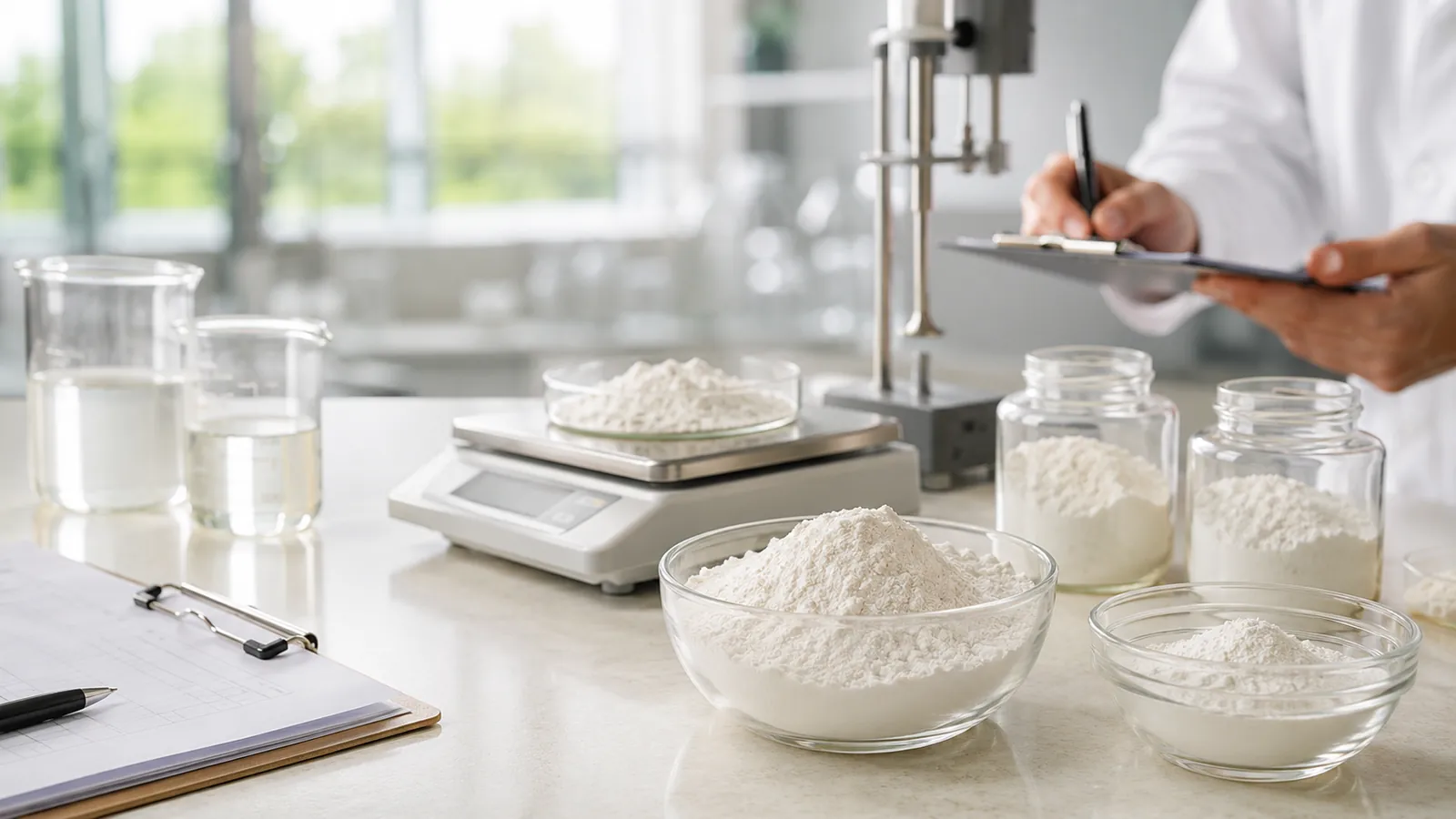
Modified potato starch powder - food-grade bulk supply from Junsheng

Start from Your Processing Problem

Choose modified potato starch by the failure you need to solve

A professional grade-selection discussion starts with the finished food and the point where the current starch system fails. Share pH, heat profile, shear, holding time, refrigeration or freezing conditions, target texture and the current benchmark so the candidate grade can be tested against a measurable problem.

01

Sauce, filling or gravy loses body during processing

If viscosity falls during acidification, high-speed mixing, pumping, prolonged heating or hot holding, compare a modified starch grade under the same solids, pH, temperature and shear history. Measure cling, pumpability, gloss, water separation and texture after the complete process rather than judging only the first cooked viscosity.

02

Frozen or chilled food releases water during storage

Syneresis, purge and texture loss may appear only after cooling, freezing, thawing or reheating. A suitable modified starch route can be screened for better storage stability, but the complete storage cycle must be reproduced because fresh-paste viscosity cannot predict freeze-thaw performance.

03

You need rapid hydration before full cooking

If the main requirement is cold- or warm-water hydration rather than process tolerance, compare Pregelatinized Potato Flour as a separate route. Modified starch and pregelatinization solve different technical problems, and some commercial grades may combine technologies, so approve the exact product code rather than the category name.

Product Understanding

What is Modified Potato Starch?

Modified potato starch is potato starch whose functional properties are deliberately adjusted for a defined food-processing requirement. The commercial value lies in matching a particular grade to a real processing stress, not in the word modified itself.

Native potato starch can produce strong viscosity after gelatinization, but its paste may be sensitive to acid, mechanical shear, long heating, cooling or frozen storage. Modification changes selected starch characteristics so the supplier can offer grades with different viscosity profiles, water-management behavior, texture contribution or process tolerance.

The same regulatory family can contain more than one commercial grade. DM-750 and DM-754 in the supplied quality reports are both identified as Hydroxypropyl Distarch Phosphate, yet their reported fineness and hydroxypropyl content are different. This is a useful reminder that buyers should qualify the exact model, current TDS and sample rather than purchase from the additive name alone.

Modified potato starch is also not interchangeable with Potato Flakes or Potato Granules. Flakes and granules are dehydrated whole-potato ingredients that contribute potato solids, flavor and their own hydration behavior; modified starch is selected mainly for thickening, binding, stability and water control. They may be used together when each ingredient has a separate, tested function in the formulation.

Grade Portfolio

Use the grade identity as the starting point, then validate the process

The broader portfolio can include E1404, E1412, E1414, E1420, E1422, E1440, E1442 and E1450 references. The supplied reports add concrete examples for Hydroxypropyl Distarch Phosphate and Oxidized Starch, but the final commercial grade must still be selected by application, regulation, test method and production conditions.

Hydroxypropyl Distarch Phosphate · DM-750

The supplied DM-750 quality report identifies the product as Hydroxypropyl Distarch Phosphate, packed 25 kg per bag and evaluated to GB 29931-2013 plus internal controls. Use the report as a reference QC profile for this specific grade, then confirm functional properties through the current TDS and your application trial.

Hydroxypropyl Distarch Phosphate · DM-754

DM-754 is also identified in the supplied report as Hydroxypropyl Distarch Phosphate with 25 kg packaging and the same GB 29931-2013 basis. Its reported fineness and hydroxypropyl content differ from DM-750, demonstrating why the exact model number matters during supplier qualification.

Oxidized Starch · DM-802

The supplied DM-802 report identifies Oxidized Starch in 25 kg packaging and evaluates the listed quality items to GB 29927-2013 plus internal controls. Its QC profile includes moisture, pH, whiteness, fineness, carboxyl content, sulfur dioxide residue and heavy-metal limits.

Other modified starch requirements

If your specification calls for another E-number, INS identity, viscosity curve, declaration or process-performance target, send the exact requirement before sampling. The product identity, botanical source, permitted use and destination-market labeling should all be confirmed on the commercial TDS and ingredient statement.

The supplied reports are evidence for the named samples or production batches, not a universal specification for every shipment. In particular, the reports do not independently state the botanical starch source; before publishing or contracting a grade as potato-derived, confirm the current TDS, ingredient declaration and supply-chain documentation for the exact commercial product.

Reference Quality Data from Supplied Reports

Concrete batch and model data your procurement team can review

Instead of showing only generic claims, this section records the values visible in the four reports you supplied. These values are presented as reference evidence for the reported grade or batch and should not be merged into one guaranteed specification.

DM-750 and DM-754 are manufacturer quality reports for Hydroxypropyl Distarch Phosphate. Both use GB 29931-2013 as the national-standard basis and list 25 kg packaging, but they show different measured values for drying loss, fineness and hydroxypropyl content. This supports model-level qualification rather than purchasing only by additive name.

DM-802 and the separate third-party report both concern Oxidized Starch and reference GB 29927-2013, but they are different production dates or batches and therefore should remain separate records. The third-party report states that the tested items complied with GB 29927-2013 and includes identification tests in addition to analytical results.

DM-750Hydroxypropyl Distarch Phosphate

Reference QC report dated 2026-05-28; production date 2026-05-27; 25 kg per bag; GB 29931-2013 plus internal control requirements.

Loss on drying4.9%
pH6.7
Specks0.10 / cm²
Whiteness89.9%
Fineness through 80 mesh94.5%
Residual phosphate<0.04%
Hydroxypropyl4.2 g/100g
SO₂ residue5.9 mg/kg
Total arsenic<0.5 mg/kg
Lead<1.0 mg/kg
DM-754Hydroxypropyl Distarch Phosphate

Reference QC report dated 2026-05-27; production date 2026-05-26; 25 kg per bag; GB 29931-2013 plus internal control requirements.

Loss on drying6.6%
pH6.5
Specks0.10 / cm²
Whiteness89.2%
Fineness through 80 mesh99.8%
Residual phosphate<0.04%
Hydroxypropyl2.9 g/100g
SO₂ residue5.6 mg/kg
Total arsenic<0.5 mg/kg
Lead<1.0 mg/kg
DM-802Oxidized Starch

Reference QC report dated 2025-01-12; production date 2025-01-11; 25 kg per bag; GB 29927-2013 plus internal control requirements.

Loss on drying13.4%
pH6.8
Specks0.07 / cm²
Whiteness95.6%
Fineness through 100 mesh99.9%
Carboxyl0.6 g/100g
SO₂ residue4.9 mg/kg
Total arsenic<0.5 mg/kg
Lead<0.1 mg/kg
Third-party reportOxidized Starch · commissioned laboratory test

Batch / production date 2026-01-03; 25 kg per bag; shelf-life date shown as 2028-01-02; tested to GB 29927-2013. The report concludes that the tested items complied with the standard.

AppearanceWhite powder, no visible impurities
Loss on drying12.4%
Total arsenicNot detected; LOQ 0.03 mg/kg
LeadNot detected; LOQ 0.05 mg/kg
SO₂ residue<2.0 mg/kg
Carboxyl0.16 g/100g
Microscopic identificationPassed
Iodine staining identificationPassed
Copper reduction identificationPassed

Important for supplier qualification: these reports verify only the listed analytical or identification items for their respective samples. They do not prove sauce stability, freeze-thaw stability, shear tolerance, retort tolerance or a potato botanical source. Request the exact current TDS, ingredient statement, batch COA and application sample for the commercial grade you intend to buy.

Technical Selection

Six technical questions to answer before selecting a modified starch grade

Translate the finished-food requirement into measurable processing conditions. The more accurately you describe the real process, the easier it is to shortlist a grade and design a meaningful trial instead of comparing brochures. Technical review can cover particle or mesh size, moisture, bulk density, color, flavor, odor, microbiological specification, shelf life, storage conditions, food safety, traceability, sample evaluation, heat resistance or heat-resistant performance, shear stability, freeze-thaw stability, acid stability, process tolerance, viscosity stability, water-holding capacity, paste clarity, short or creamy texture, cold viscosity and texturizing behavior. Halal and FSSC 22000 evidence should be checked against the current product scope; Kosher status must be separately verified if a buyer requires it.

01

Heat profile

Record heating temperature, ramp time, hold time and whether the product is pasteurized, sterilized, baked, fried or reheated. A short kettle cook and a long retort cycle are not equivalent stresses.

02

pH and acid source

Share the final pH and when acid is added. Citric acid, acetic acid and other acid systems may interact differently with solids, salts and the starch paste, so the full formula matters.

03

Mechanical shear

Describe high-speed mixing, pumping, homogenization, filling and recirculation. Compare viscosity and finished texture after the real shear history rather than before the product enters the line.

04

Cooling, chilling and freezing

If the product is chilled or frozen, reproduce the complete cooling, storage, thawing and reheating cycle. Measure water separation, purge, texture and viscosity after storage.

05

Target viscosity and texture

Define the measurement method and the sensory target. Pumpability, cling, body, gloss, bite, cut quality or spoonability can be more meaningful than a single maximum viscosity value.

06

Regulatory and label requirements

Confirm the exact additive identity, permitted use, declaration wording, botanical source and destination-market requirements before commercial approval. Technical fit and regulatory fit must both be satisfied.

Application Selection

Where modified potato starch is commonly evaluated in food processing

These are application-screening directions, not claims proven by the supplied QC reports. The exact grade should be tested in the real formula, equipment and storage condition because different applications expose starch to different stresses. Application screening may include soups, sauces and dressings, ready meals, frozen and freeze-thaw foods, processed meat and seafood, bakery or fruit and cream fillings, dairy and dairy desserts, plant-based foods, snack foods, batters and coatings, instant and convenience foods, noodles, thickening, texture improvement, binding, water retention, high-shear processing, retort or UHT conditions, acidic foods and refrigerated storage. Select by the actual stress profile and finished texture, not by a generic claim that every modified starch tolerates every process.

Sauces, gravies and fillings

Evaluate viscosity retention, cling, gloss, pumpability and water separation after acidification, cooking, shear, hot holding and reheating. Modified potato starch for sauces should be selected against the complete process, not only a Brookfield or RVA number.

Frozen prepared foods

For frozen meals, fillings and potato-based sides, compare syneresis, purge, texture and reheating behavior after the intended storage cycle. Freeze-thaw performance is grade-dependent and should never be assumed from the word modified alone.

Meat and seafood products

A suitable grade may be evaluated for binding, water management, yield and texture in selected systems. Measure cook loss, purge, bite, sliceability and storage performance while respecting the destination-market formulation rules.

Noodles and formed foods

Where starch contributes processability, bite or cooking stability, compare dough handling, sheet integrity, cooking loss, texture and holding. The grade should support the product target without creating excessive gumminess.

Fabricated potato chips and snacks

Potato Flakes or Potato Granules can provide whole-potato solids, while modified potato starch can address a separate binding or texture function. Rebalance water and solids and validate sheeting, forming, frying color, breakage and crispness in the full formula.

Coatings, bakery and convenience foods

Evaluate adhesion, viscosity, bake or fry behavior, moisture migration and storage texture according to the product. Use the same application method and process sequence when comparing candidate suppliers.

Choose the Correct Potato Ingredient

Modified Potato Starch vs Native Potato Starch vs Pregelatinized Potato Flour

These ingredients can all contribute structure or viscosity, but they solve different problems. Use this comparison to choose the right technical route before asking for a sample. Research typically asks what modified potato starch is, what it is used for, how to choose a grade, how to read a specification guide, how to select starch for retort or high-shear processing, how to evaluate quality, how meat-binding applications should be tested, and how to use a bulk buying, sourcing or procurement guide. Compare modified versus native potato starch, corn starch, tapioca starch and pregelatinized starch by functional objective and process window. The exact commercial grade, not the generic comparison term, must be supported by current documentation and trial data.

Primary roleTargeted process stability and texture controlNatural starch thickening after gelatinizationRapid hydration and early viscosity development
Heating requirementDepends on exact gradeNormally requires sufficient heatingDesigned for faster cold- or warm-water functionality
Acid / shear toleranceGrade-specific options may be availableGenerally more sensitiveNot automatically equivalent to process-stable modified starch
Freeze-thawGrade-specific options may be evaluatedCan be limitedPregelatinization alone does not guarantee freeze-thaw stability
Best selection methodProcess stress + sample trial + TDSHeated-system trial + viscosity methodDispersion + hydration + final texture trial
Relation to Flakes / GranulesFunctional starch componentFunctional starch componentFast-functional powder; separate from whole-potato solids

OEM / ODM Product Customization

Customize the commercial grade around measurable requirements

For qualified projects, customization can cover both technical targets and packaging. Final targets must remain inside a stable manufacturing and regulatory window and should be locked through an approved sample, agreed test method and signed specification.

Grade and functional route

Start from the requested additive identity, process stress and label requirement. We can discuss which grade family should enter the trial rather than treating all modified starches as interchangeable.

Analytical and physical targets

Feasible ranges for moisture, pH, whiteness, fineness, viscosity or other release items can be discussed for the selected grade. Methods, units, tolerances and COA items must be agreed in advance.

Application performance target

Define the measurable finished-food requirement such as viscosity retention, water separation, yield, texture, pumpability or storage stability. Application targets require plant or pilot validation and cannot be guaranteed from a QC certificate alone.

Packaging and private label

Bag weight, multilingual labeling, customer artwork, barcode, shipping marks, palletization and private-label requirements can be coordinated with product qualification, MOQ and export planning.

Sample and Plant Trial

How to qualify modified potato starch before bulk purchasing

A useful trial reproduces the exact process stress the buyer wants the starch to survive. Use a control and candidate under the same formula and equipment conditions, then lock the approved grade and test method before repeat orders.

01

Define the current failure

Describe where the existing system fails: viscosity loss, water release, weak binding, poor hot-hold stability, filling inconsistency, freeze-thaw damage or another measurable issue. Send the current benchmark and target if available.

02

Match real process conditions

Run the same solids, pH, salt, acid source, addition sequence, heating, shear, cooling and storage conditions for the control and candidate. Changing multiple variables at once makes supplier comparison unreliable.

03

Measure the finished-food result

Record process viscosity, but also evaluate yield, purge, syneresis, pumpability, cling, cut quality, bite, reheating and storage texture according to the product. The final food result is the real acceptance criterion.

04

Lock the approved commercial baseline

After approval, align product code, botanical source statement, TDS, signed specification, test methods, COA items, packaging and change-notification expectations. Repeat shipments should be compared against this same baseline.

Documents and Quality Control

Build supplier approval around the exact grade and batch

The supplied reports show why document-level detail matters: grade code, production date, standard, test method and batch result can all change the meaning of a number. Ask for documents that correspond to the exact commercial product being ordered. Commercial requests can include wholesale or factory price, price per ton, FOB or CIF terms, MOQ, sample request, 25 kg bags, bulk and export packaging, container load planning, 20ft or 40ft containers, international shipping, lead time and export documents. Buyers in Europe, the Middle East, Southeast Asia, South Asia, Africa, Latin America, North America and Australia — including Saudi Arabia, UAE, Indonesia, Malaysia, Philippines, Thailand, Vietnam, India, Mexico and Brazil — should also confirm local additive, labeling and import rules before approving a grade.

Grade-specific TDS

Confirm product identity, botanical source, functional description, analytical or physical limits, storage, packaging and test-method notes. The TDS should match the sample and grade quoted for commercial supply.

Batch COA

Agree the release items and methods that will appear on each batch COA. Use the COA for shipment-level verification and keep buyer and supplier methods aligned so results are comparable.

Inspection and compliance records

Where required, review relevant national-standard tests, third-party inspection, food-safety documents, additive identity and destination-market regulatory requirements. Do not present a report from one batch as proof for every future batch.

Traceability and change control

Lot coding, retained samples, production records and change notification support repeat-order consistency and complaint investigation. For custom grades, define what changes require customer review or requalification.

Supplier Comparison

Compare modified potato starch suppliers with the same technical baseline

Price per metric ton is only one part of the decision. A useful comparison uses the same grade requirement, formula, process stress, test method and acceptance criteria so procurement can see whether a lower price creates hidden yield, stability or rework costs.

Ask every candidate supplier to identify the exact commercial grade and provide a matching sample, TDS and batch-quality route. Compare process performance, documentation, traceability, MOQ, lead time and technical response, then calculate the impact on finished-product consistency and total cost. Modified-starch sourcing can involve a manufacturer, producer, exporter, wholesale supplier, distributor, B2B supplier, commercial supplier, industrial supplier, import supplier or export supplier. Procurement teams should qualify the exact model and modification rather than the category label, especially when comparing food manufacturers' requirements, large-scale production or factory-direct supply. Current project evidence verifies hydroxypropyl distarch phosphate reference grades and oxidized starch reports; other terms such as stabilized, cross-linked or acetylated potato starch require grade-specific evidence before they are treated as available products.

  • Exact product code and additive identity
  • Botanical source confirmed in TDS or ingredient statement
  • Matching sample and grade-specific TDS
  • Agreed viscosity or functional test method
  • pH, heat and shear trial conditions
  • Freeze-thaw or chilled-storage test when relevant
  • Batch COA release items
  • Traceability and retained-sample policy
  • MOQ, 25 kg packaging and pallet plan
  • FOB / CFR / CIF and export-document support

Buyer FAQ

Modified Potato Starch Questions from Procurement and R&D Teams

The answers below use the supplied reports where they provide concrete evidence and keep application guidance separate. Final commercial approval still depends on the exact grade, current TDS, botanical-source statement, sample test, signed specification and batch COA. A sourcing file should define commercial, quality, technical and product specifications; sample and quotation; TDS and COA; bulk or export packaging; import and export requirements; shipping and storage requirements; supplier checklist; quality control and inspection; batch consistency and stable supply. That structure is useful for importers, distributors, wholesalers, food manufacturers and international buyers because it separates verified grade evidence from marketing descriptions and makes a global-supplier comparison more defensible.

What modified starch grades are shown in the supplied reports?

The supplied materials include Hydroxypropyl Distarch Phosphate grades DM-750 and DM-754 and Oxidized Starch grade DM-802, plus a separate third-party Oxidized Starch report. The broader website portfolio may reference other E-number or INS categories, but those are not verified by these four reports.

Are DM-750 and DM-754 the same product?

Both supplied reports identify Hydroxypropyl Distarch Phosphate, but the model numbers and measured QC profiles differ. For example, reported fineness through 80 mesh is 94.5% for DM-750 and 99.8% for DM-754, while hydroxypropyl is 4.2 and 2.9 g/100g respectively, so the exact model should be qualified.

What does the DM-802 report show?

The supplied DM-802 Oxidized Starch report lists 13.4% loss on drying, pH 6.8, whiteness 95.6%, 99.9% fineness through 100 mesh, carboxyl 0.6 g/100g and other listed safety or quality results. The report concludes that the listed items passed the applicable requirements.

What additional value does the third-party Oxidized Starch report provide?

The third-party report independently records a different Oxidized Starch sample or batch against GB 29927-2013. It reports 12.4% loss on drying, carboxyl 0.16 g/100g, sulfur dioxide below 2.0 mg/kg, arsenic and lead not detected at the stated quantification limits, and passed identification tests.

Do these reports prove the starch is potato-derived?

The reports identify the modified-starch type and analytical results but do not independently state the botanical source. If botanical source matters to your label, formulation or customer approval, request the current TDS, ingredient statement and supply-chain declaration for the exact commercial grade.

Do these QC reports prove heat, acid, shear or freeze-thaw stability?

No. The reports contain identity and analytical or quality-control items, not full application-performance trials. Heat, acid, shear, retort, chilling or freeze-thaw performance must be confirmed with grade-specific technical data and a controlled trial in the real formulation.

Can modified potato starch be used with Potato Flakes or Potato Granules?

Yes, when the functions are separated clearly. Potato Flakes or Potato Granules can provide whole-potato solids, flavor and hydration behavior, while modified starch can address a different binding, viscosity, water-control or stability requirement. Rebalance water and solids and validate the complete formula.

Can you customize modified starch specifications?

For qualified OEM or ODM projects, feasible grade selection, analytical targets, functional targets and packaging can be discussed. Final custom requirements need sample validation, an agreed method, MOQ review, signed specification and batch-release plan.

What should I send for a modified starch quotation?

Send the finished product, requested additive identity or current grade, pH, heat and shear conditions, storage route, target viscosity or texture, annual or trial quantity, packaging, destination port and required documents. This allows a technical and commercial response rather than a generic price only.

Which documents should be checked before a bulk order?

Request the exact grade TDS, botanical-source or ingredient statement, approved sample reference, agreed specification, batch COA route, relevant compliance documents, packaging details and traceability information. If third-party testing is required, define the batch and test scope before shipment.

RFQ · Samples · TDS · COA

Tell us the process stress, grade identity and quality evidence you need.

Share your finished product, requested modified starch type, pH, heating, shear, storage condition, target viscosity or texture, quantity, destination and document requirements. We can use the supplied grade framework and your application conditions to prepare a more precise sample, TDS and bulk-supply discussion.